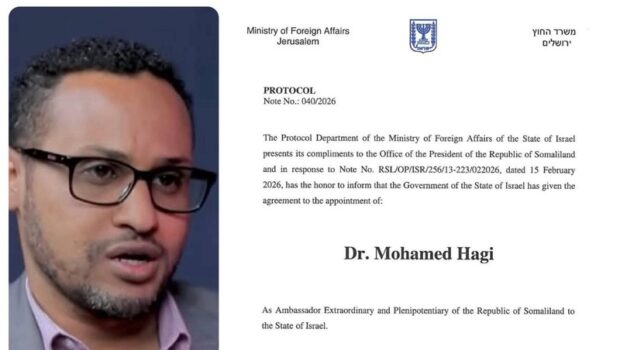
Somaliland / Somalie : Israël accrédite officiellement le premier ambassadeur du Somaliland, un séisme diplomatique dans la Corne de l’Afrique

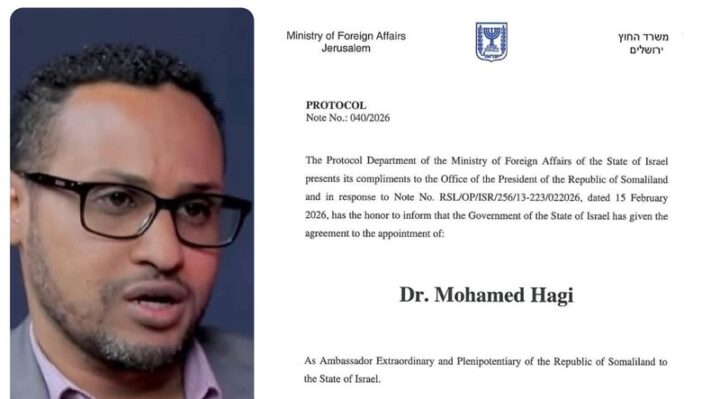
Dans un développement diplomatique majeur, le ministère israélien des Affaires étrangères a officialisé, le 23 février 2026, l’agrément pour la nomination du Dr Mohamed Hagi en tant qu’ambassadeur extraordinaire et plénipotentiaire de la République du Somaliland auprès de l’État d’Israël. Cette décision, matérialisée par la note protocolaire n° 040/2026, marque une nouvelle étape concrète dans le rapprochement entre Israël et cette région séparatiste de la Somalie, deux mois seulement après la reconnaissance historique de son indépendance par l’État hébreu.
1. Un coup de tonnerre à Mogadiscio : la souveraineté somalienne bafouée ?
Pour le gouvernement fédéral de Mogadiscio, cette nomination est perçue comme une provocation et une escalade inacceptable. Bien que la reconnaissance de décembre 2025 par Israël ait déjà été qualifiée de « violation grave du droit international » par l’ambassadrice de Somalie en Chine, Hodan Osman Abdi, l’arrivée d’un ambassadeur somalilandais à Jérusalem officialise un lien diplomatique permanent.
Le président somalien Hassan Sheikh Mohamud a réitéré son opposition farouche, dénonçant une « ingérence » d’Israël dans les affaires intérieures de son pays. Dans une interview récente, il a clairement affirmé que son gouvernement « ne permettra jamais » l’établissement d’une base militaire israélienne à Berbera et qu’il était prêt à « affronter toute force israélienne » qui pénétrerait sur un territoire qu’il considère comme le sien. Pour Mogadiscio, cette accréditation fragilise un peu plus l’intégrité territoriale du pays à un moment critique de sa reconstruction et de sa lutte contre les groupes insurgés comme les shebab. La Somalie, soutenue par la Ligue arabe et l’Union africaine, considère cet acte comme nul et non avenu, susceptible d’encourager d’autres mouvements séparatistes sur le continent.
2. Un levier inespéré pour le Somaliland sur la scène internationale
À l’inverse, pour la République autoproclamée du Somaliland, cette nomination est une victoire diplomatique sans précédent. Depuis sa déclaration d’indépendance en 1991, Hargeisa cherche désespérément une reconnaissance internationale qui lui permettrait de sortir de son isolement, malgré une stabilité relative, sa propre monnaie, son armée et ses institutions démocratiques.
L’ouverture d’une ambassade à Jérusalem, avec un ambassadeur en titre, transforme un geste symbolique en une relation bilatérale fonctionnelle. Le président Abdirahman Mohamed Abdullahi (dit Cirro) voit en Israël une porte d’entrée vers une légitimité globale et potentiellement un soutien américain, d’autant que l’État hébreu a promis une coopération dans les domaines de l’agriculture, de la technologie et de la santé. Le Somaliland espère que cette percée diplomatique, bien que controversée, fera tache d’huile et lui permettra de faire partie des Accords d’Abraham, consolidant ainsi son statut d’État de facto.
3. Le rôle clé de l’ambassadeur Mohamed Hagi
La nomination du Dr Mohamed Hagi n’est pas anodine. Selon le ministère israélien, il a joué un rôle déterminant tout au long de l’année 2025 pour promouvoir l’établissement des relations entre les deux parties. Ancien conseiller du président du Somaliland, il est perçu comme un artisan majeur de ce rapprochement. Sa mission en tant qu’ambassadeur extraordinaire et plénipotentiaire sera cruciale pour concrétiser les accords annoncés, notamment après la visite historique du chef de la diplomatie israélienne Gideon Saar à Hargeisa en janvier dernier. Il devra également naviguer dans un contexte local délicat : une partie de la population somalilandaise, profondément musulmane, reste méfiante vis-à-vis d’Israël, surtout dans le contexte de la guerre à Gaza. La gestion de cette sensibilité interne sera l’un de ses premiers défis.
4. Une recomposition stratégique dans la Corne de l’Afrique et en mer Rouge
Au-delà des aspects bilatéraux, cette nomination s’inscrit dans une vaste recomposition géopolitique. Pour Israël, l’enjeu est avant tout stratégique et sécuritaire. La position du Somaliland, sur le golfe d’Aden, fait face au Yémen contrôlé en partie par les rebelles Houthis. Cette alliance offre à Tel-Aviv une tête de pont idéale pour surveiller le détroit de Bab-el-Mandeb, l’une des routes maritimes les plus fréquentées au monde, et contrer l’influence de l’Iran dans la région.
Cette décision a également pour effet de bousculer les équilibres régionaux. Elle constitue un revers pour la Turquie, principal allié de la Somalie et puissance montante dans la région avec sa base militaire TURKSOM. En revanche, elle pourrait profiter à l’Éthiopie, qui cherche un accès à la mer, et aux Émirats arabes unis, déjà présents via la gestion du port de Berbera et partenaires d’Israël dans le cadre des Accords d’Abraham.
Cependant, cette percée israélienne suscite de vives inquiétudes. Les Houthis ont déjà menacé de considérer toute présence israélienne au Somaliland comme une « cible militaire ». L’Égypte craint une fragmentation des États arabes africains et une instabilité chronique qui menacerait la sécurité de l’ensemble du bassin de la mer Rouge. Enfin, si les États-Unis n’ont pas officiellement suivi le mouvement israélien, l’administration Trump a promis d’ « étudier » la question, tandis que la Chine et la Russie réaffirment leur attachement à l’intégrité territoriale de la Somalie. La nomination du Dr Mohamed Hagi pourrait donc bien n’être que le premier acte d’une nouvelle pièce géopolitique qui se joue sur les rives de la mer Rouge.
Hassan Cher
The English translation of the article in French.
Somaliland / Somalia: Israel Officially Accredits Somaliland’s First Ambassador, a Diplomatic Earthquake in the Horn of Africa
In a major diplomatic development, Israel’s Ministry of Foreign Affairs officially granted agrément on 23 February 2026 for the appointment of Dr. Mohamed Hagi as Ambassador Extraordinary and Plenipotentiary of the Republic of Somaliland to the State of Israel. Formalized through Protocol Note No. 040/2026, this decision marks a further concrete step in the rapprochement between Israel and the Somali breakaway region, just two months after the historic recognition of its independence by the Jewish state.
1. Shockwaves in Mogadishu: Somali Sovereignty Undermined?
For the Federal Government in Mogadishu, the appointment is viewed as a provocation and an unacceptable escalation. Although Israel’s December 2025 recognition had already been described as a “serious violation of international law” by Somalia’s ambassador to China, Hodan Osman Abdi, the arrival of a Somaliland ambassador in Jerusalem formalizes a permanent diplomatic link.
Somali President Hassan Sheikh Mohamud has reiterated his firm opposition, denouncing what he called Israeli “interference” in his country’s internal affairs. In a recent interview, he stated unequivocally that his government “will never allow” the establishment of an Israeli military base in Berbera and that it stands ready to “confront any Israeli force” entering territory it considers its own. For Mogadishu, this accreditation further weakens the country’s territorial integrity at a critical moment in its reconstruction and its fight against insurgent groups such as Al-Shabaab. Somalia—backed by the Arab League and the African Union—considers the move null and void and fears it could encourage other separatist movements across the continent.
2. An Unexpected Lever for Somaliland on the International Stage
Conversely, for the self-declared Republic of Somaliland, the appointment represents an unprecedented diplomatic victory. Since declaring independence in 1991, Hargeisa has sought international recognition that would allow it to emerge from isolation, despite relative stability, its own currency, army, and democratic institutions.
The opening of an embassy in Jerusalem, with a fully accredited ambassador, transforms a symbolic gesture into a functional bilateral relationship. President Abdirahman Mohamed Abdullahi (known as Cirro) views Israel as a gateway to broader international legitimacy and potentially to U.S. support, especially as Israel has pledged cooperation in agriculture, technology, and health. Somaliland hopes this controversial diplomatic breakthrough will create a ripple effect and enable it to join the Abraham Accords, thereby consolidating its de facto statehood.
3. The Key Role of Ambassador Mohamed Hagi
The appointment of Dr. Mohamed Hagi is far from incidental. According to Israel’s foreign ministry, he played a decisive role throughout 2025 in promoting the establishment of relations between the two sides. A former adviser to the Somaliland president, he is widely seen as a principal architect of the rapprochement. His mission as Ambassador Extraordinary and Plenipotentiary will be crucial in implementing the announced agreements, particularly following Israeli Foreign Minister Gideon Saar’s historic visit to Hargeisa last January.
He will also have to navigate a sensitive domestic environment: part of Somaliland’s deeply Muslim population remains wary of Israel, especially in the context of the Gaza war. Managing this internal sensitivity will be among his first major challenges.
4. Strategic Realignment in the Horn of Africa and the Red Sea
Beyond the bilateral dimension, the appointment forms part of a broader geopolitical realignment. For Israel, the stakes are primarily strategic and security-driven. Somaliland’s position on the Gulf of Aden faces Yemen, partly controlled by Houthi rebels. This partnership offers Tel Aviv an ideal foothold to monitor the Bab el-Mandeb Strait—one of the world’s busiest maritime routes—and to counter Iranian influence in the region.
The move also disrupts regional balances. It represents a setback for Turkey, Somalia’s main ally and an emerging regional power through its TURKSOM military base. Conversely, it could benefit Ethiopia, which is seeking sea access, and the United Arab Emirates, already present through its management of the Port of Berbera and a partner of Israel under the Abraham Accords.
However, Israel’s advance is raising serious concerns. The Houthis have already threatened to treat any Israeli presence in Somaliland as a “military target.” Egypt fears the fragmentation of Arab African states and chronic instability that could threaten security across the entire Red Sea basin. Finally, while the United States has not officially followed Israel’s move, the Trump administration has pledged to “review” the issue, while China and Russia continue to reaffirm their commitment to Somalia’s territorial integrity. The appointment of Dr. Mohamed Hagi may therefore be only the opening act of a new geopolitical drama unfolding along the shores of the Red Sea.
Hassan Cher


 Next Article
 Djibouti/Somalie : Ismaël Omar Guelleh a officiellement octroyé la nationalité djiboutienne au colonel Abdourahman Aden Abdoulkader dans l’unique but de narguer les États-Unis.
  Djibouti / Chine : Par des explosions, la Chine détruit la faune sous-marine à Djibouti et met en danger la navigation du Bab-el-Mandeb
  Djibouti : Haïbado Ismaël Omar Guelleh a détourné 4 à 6 millions de dollars US de la Caisse Nationale de Sécurité sociale (CNSS).
  Djibouti : Gouled Ahmed Youssouf confirme dans son discours les trafics du régime de Guelleh et les détournements des recettes de l’état djiboutien.
  Corne de l’Afrique ; la réunion tripartite d’Asmara, pressions politiques et implications géostratégiques dans la Corne de l’Afrique
  Djibouti : Le régime mafieux de Guelleh confirme que le pays croule sous la corruption institutionnalisée
  Djibouti/Chine/DP World : La base militaire chinoise à Djibouti serait-elle à l’image du contrat de 50 ans signé avec… ?
  Djibouti/Érythrée: Ismaël Omar Guelleh veut relancer la guerre avec Asmara pour calmer les mécontentements de l’intérieur.