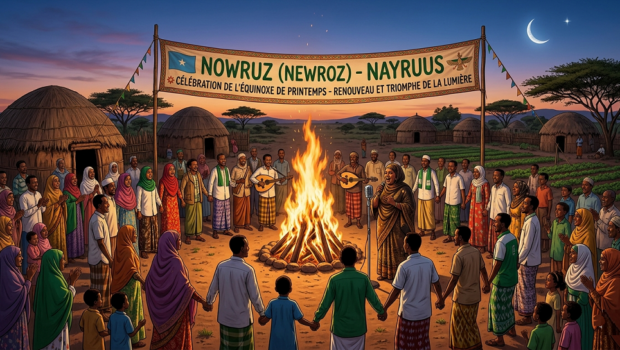
Corne de l’Afrique : La confédération ethnique somalienne et la célébration du Norouz (ou Newroz), Nouvel An des traditions ancestrales

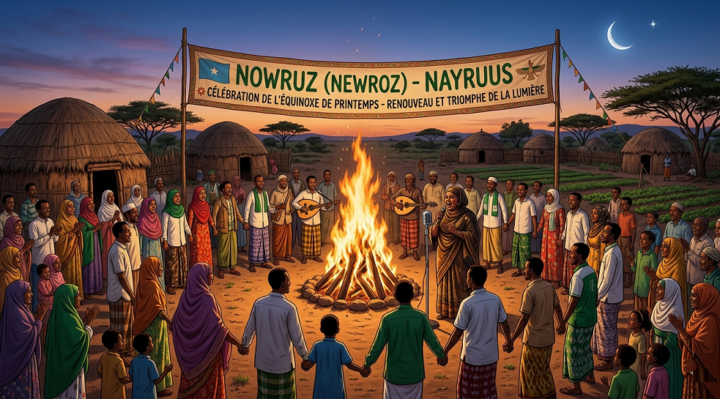
En 2026, le Norouz (ou Newroz), le Nouvel An perse célébré depuis plus de 3 000 ans comme une fête printanière aux racines zoroastriennes, aura lieu le vendredi 20 mars 2026, lors de l’équinoxe de printemps. Ce moment précis symbolise la renaissance de la nature et marque le début de l’année 1405 dans le calendrier persan.
Informations clés
- Date précise : 20 mars 2026 (équinoxe).
- Signification : « Nouveau Jour », symbole de renouveau et du triomphe de la lumière.
- Célébration : Il s’agit d’une fête laïque et culturelle célébrée dans de nombreuses régions et communautés, notamment dans la Corne de l’Afrique, en Iran, chez les Kurdes, ainsi qu’au Kazakhstan, au Kirghizistan, au Tadjikistan, au Turkménistan, en Ouzbékistan, en Azerbaïdjan, en Afghanistan, en Turquie et chez les Ouïghours.
Heestii : NAYRUUS WAA CID / Interprètes : Tubeec & Magool
Fanaan TUUBEC
Nayruusku Waa Cid, Waa Negi Aduunyadu (refrain)
Waa Nuur Kalgacalkuye Naruruooy, Waa Nuur Kalgacalkuye Nasteexooy (refrain)
Naftu Mow Xiddigisaa, Nacab Mayska Celisaa, Waxaad Naawilaysiyo, Naqu Makuu Cuntamaya ? (refrain) Innaguna Nasiibkeen, Nasiibkaa Nasiibkey Maku Naaxi Doona? (refrain)
Caashaquna Neeca wda, Maku Neefsan Dona? (refrain)
Traduction du somali vers le français :
« Le Nayruus est un jour de fête, une bénédiction pour le monde.
C’est une lumière de bienveillance, ô Naruruooy (prénom donné à une fille née en période de grâce),
C’est une lumière d’amour, ô Nasteexooy (prénom donné à une fille dont les parents traversent une période d’harmonie).
Consulteras-tu l’horoscope de cette âme qui t’aime ?
Saura-tu repousser la haine ?
Ce que tu espères atteindre, en seras-tu satisfait et comblé de bonheur ?
Quant à notre destinée — la mienne et la tienne — seront-elles un jour unies ?
Et l’amour qui nous lie, pourra-t-il enfin respirer le parfum de la pluie ? »
Fanaanada MAGOOL
Nayruusku Waa Cid, Waa Negi Aduunyadu
Waa Naar Kalgacalkuye Nasibow, Waa Naar Kalgacalkuye Naftaydoow
Nabbaraa i Gaadhoo Ma Nuuxnuuxsan Karaye, Anigay Noqnoqoshadu i Naanaabinaysaa
Sidan Kuugu Nabanahay, Hadaad iigu Nudan Tahay, Amaad iigu Nugushahay
Xiskeenoo Nagaadiyo Waa Waa, Nimca La’arki Doonee.
Traduction du somali vers le français :
« Le Nayruus est un jour de fête, une bénédiction pour le monde.
L’amour est un feu, ô mon destin,
L’amour est un feu, ô mon âme.
Je ne parviens pas à surmonter mes blessures émotionnelles,
Et ton indécision ne fait qu’aggraver ma peine.
Puisque je me suis attaché à toi,
Si tu m’es aussi cher que le souffle de la vie (litt. « si tu m’es collé comme la graisse péricardique »),
Si tu faisais preuve d’empathie envers moi,
Notre amour complice serait éternel,
Et nous connaîtrions ensemble la prospérité. »
Contexte historique et culturel
Avant l’introduction de l’islam dans la Corne de l’Afrique, et particulièrement au sein de la confédération ethnique somalienne, plusieurs autres systèmes de croyances étaient pratiqués par ce grand peuple.
À certaines périodes de l’histoire du peuple somalien, l’Empire perse devint un partenaire privilégié pour le commerce et les échanges de biens. On estime qu’à cette époque, l’Empire perse a réussi à exporter vers l’Afrique de l’Est les rituels et les traditions du zoroastrisme, notamment la variante Fasli du calendrier zoroastrien qui célèbre le Norouz comme le premier jour de la nouvelle année. À l’instar des Kurdes, sur l’ensemble du territoire somalien, les habitants de chaque campement, village ou ville chantaient et dansaient joyeusement autour de grands bûchers.
Aujourd’hui encore, bien que l’islam soit la religion de l’immense majorité des Somaliens, la fête du Norouz continue d’être célébrée dans certains endroits. La célèbre chanteuse somalienne, feue Haliimo Khaliif Magool, a d’ailleurs interprété une chanson très connue intitulée « Neyruusku waa ciid waa negi aduunyadu… », ce qui signifie en français : « Le Nayruus est un jour de fête, une bénédiction pour le monde. »
En cette année 2026, la fête du Norouz coïncide avec la fête musulmane de l’Aïd el-Fitr, qui célèbre la fin du mois de Ramadan.
Hassan Cher
The English translation of the article in French.
Horn of Africa: The Somali Ethnic Confederation and the Celebration of Nowruz (or Newroz), New Year of Ancestral Traditions
In 2026, Nowruz (or Newroz), the Persian New Year celebrated for over 3,000 years as a spring festival with Zoroastrian roots, will take place on Friday, March 20, 2026, coinciding with the spring equinox. This precise moment symbolizes the rebirth of nature and marks the beginning of the year 1405 in the Persian calendar.
Key Information
- Exact Date: March 20, 2026 (equinox).
- Meaning: « New Day, » a symbol of renewal and the triumph of light.
- Celebration: It is a secular and cultural festival celebrated in many regions and communities, particularly in the Horn of Africa, Iran, among the Kurds, as well as in Kazakhstan, Kyrgyzstan, Tajikistan, Turkmenistan, Uzbekistan, Azerbaijan, Afghanistan, Turkey, and among the Uyghurs.
Heestii: NAYRUUS WAA CID / Performers: Tubeec & Magool
Fanaan TUUBEC
Nayruusku Waa Cid, Waa Negi Aduunyadu (refrain)
Waa Nuur Kalgacalkuye Naruruooy, Waa Nuur Kalgacalkuye Nasteexooy (refrain)
Naftu Mow Xiddigisaa, Nacab Mayska Celisaa, Waxaad Naawilaysiyo, Naqu Makuu Cuntamaya ? (refrain) Innaguna Nasiibkeen, Nasiibkaa Nasiibkey Maku Naaxi Doona? (refrain)
Caashaquna Neeca wda, Maku Neefsan Dona? (refrain)
Translation from Somali to English:
« Nayruus is a day of celebration, a blessing for the world.
It is a light of benevolence, O Naruruooy (a name given to a girl born in a period of grace),
It is a light of love, O Nasteexooy (a name given to a girl when her parents are going through a period of harmony).
Will you consult the horoscope of this soul who loves you?
Will you be able to repel hatred?
What you hope to achieve, will you be satisfied and filled with happiness?
As for our destiny — mine and yours — will they one day be united?
And the love that binds us, will it finally breathe the scent of rain? »
Fanaanada MAGOOL
Nayruusku Waa Cid, Waa Negi Aduunyadu
Waa Naar Kalgacalkuye Nasibow, Waa Naar Kalgacalkuye Naftaydoow
Nabbaraa i Gaadhoo Ma Nuuxnuuxsan Karaye, Anigay Noqnoqoshadu i Naanaabinaysaa
Sidan Kuugu Nabanahay, Hadaad iigu Nudan Tahay, Amaad iigu Nugushahay
Xiskeenoo Nagaadiyo Waa Waa, Nimca La’arki Doonee.
Translation from Somali to English:
« Nayruus is a day of celebration, a blessing for the world.
Love is a fire, O my destiny,
Love is a fire, O my soul.
I cannot overcome my emotional wounds,
And your indecision only aggravates my pain.
Since I have become attached to you,
If you are as dear to me as the breath of life (lit. « if you are stuck to me like pericardial fat »),
If you showed empathy towards me,
Our complicit love would be eternal,
And we would know prosperity together. »
Historical and Cultural Context
Before the introduction of Islam in the Horn of Africa, and particularly within the Somali ethnic confederation, several other belief systems were practiced by this great people.
At certain periods in the history of the Somali people, the Persian Empire became a privileged partner for trade and the exchange of goods. It is estimated that during this era, the Persian Empire successfully exported Zoroastrian rituals and traditions to East Africa, notably the Fasli variant of the Zoroastrian calendar which celebrates Nowruz as the first day of the new year. Like the Kurds, throughout the Somali territory, the inhabitants of every encampment, village, or town sang and danced joyfully around large bonfires.
Even today, although Islam is the religion of the vast majority of Somalis, the festival of Nowruz continues to be celebrated in some places. The famous Somali singer, the late Haliimo Khaliif Magool, also performed a very well-known song titled « Neyruusku waa ciid waa negi aduunyadu… », which means in English: « Nayruus is a day of celebration, a blessing for the world. »
In 2026, the Nowruz festival coincides with the Muslim festival of Eid al-Fitr, which celebrates the end of Ramadan.
Hassan Cher


 Next Article
 Éthiopie/Égypte : Le peuple égyptien appel à la guerre contre l’Éthiopie et une commission ad hoc du parlement donne le plein pouvoir à El-Sisi.
  Éthiopie : La guerre entre le TPLF, l’armée fédérale éthiopienne et leurs alliés a repris le 24 aout 2022 dans les régions du Nord…
  Somaliland/Djibouti : Deux hélicoptères de la force aérienne de Djibouti ont bombardé Hargeisa au mois d’avril 2019.
  Djibouti/CORONAVIRUS : La région de Dikhil affectée par le Coronavirus depuis le lundi soir 23 mars 2020.
  Djibouti/DPWorld : « Et si le pays dans lequel vous investissez faisait comme Djibouti ? Djibouti a donc créé un… mauvais précédent. »
  Djibouti/Russie : à Djibouti, la Russie va-t-elle bientôt remplacer la France dans tous les domaines ?
  Afrique de l’Est : L’ex-agent de la DGSE, DENIS ALEX, est-il victime de la guerre entre les sociétés de Telecom en Afrique de l’Est ?
  Djibouti : Cyberespionnage mondial, l’internet et les infrastructures informatiques à Djibouti gravement affectés par IMEEX et ShadowPad